History of Sebastopol, California
From Pine Grove to Wine Country Gem
Nestled in the rolling hills of Sonoma County, Sebastopol is a charming city with a rich history spanning over 170 years. Located just seven miles west of Santa Rosa and approximately 15 miles from both the Russian River and the Pacific Ocean, this unique community has evolved from a small trading post into one of California’s most beloved Wine Country destinations.
Indigenous Heritage
Long before European settlers arrived, the land that would become Sebastopol was home to the Miwok and Pomo tribes. The Pomo people were particularly renowned worldwide for their extraordinarily intricate basketry. Archaeological evidence suggests they maintained up to 11 encampments alongside the Laguna de Santa Rosa, the largest freshwater wetland in Northern California, which borders the eastern edge of modern-day Sebastopol.
Early Settlement & Spanish Land Grants
The first wave of non-indigenous settlers arrived in the early 1800s from Mexico, which was then a colony of Spain. The area was divided into Spanish land grants, including the Llano de Santa Rosa Rancho. Joaquin Carrillo became the first Sebastopol resident of European descent when he built his adobe house on this rancho in 1846. One of the earliest American settlers was Jasper O’Farrell, who purchased the Rancho Estero Americano in 1843.
The nearby Russian colony at Fort Ross, established in 1812 on the California coast north and west of Sebastopol, brought significant Russian influence to the region. Russian fur trappers are credited with planting the first Gravenstein apple seedlings in Sonoma County around 1811, beginning what would become the area’s most iconic agricultural tradition.
The Birth of a Town
As California’s population swelled during the Gold Rush of 1849, Sebastopol emerged as a trading center for area farmers. In 1850, John Walker and Joseph Miller settled near Carrillo’s adobe, with Walker opening a trading post. A post office was established the same year.
The town was formally founded in 1855 by J.H.P. Morris, who took up a claim of 120 acres on the site of a former Pomo village. Morris opened a saloon, and John Dougherty established a general merchandise store nearby in a grove of pine trees, giving the settlement its original name: Pine Grove.
How Sebastopol Got Its Name
The name change from Pine Grove to Sebastopol occurred around 1857 and has been attributed to a colorful local legend. According to tradition, a prolonged and spirited fistfight broke out in the newly formed town, reminding a bystander of the famous Siege of Sevastopol during the Crimean War (1854-1855), where British forces conducted a lengthy siege of the Russian seaport. The Crimean War was one of the first conflicts to receive extensive international journalism coverage, making “Sebastopol” a popular name across America—several other California towns briefly bore the same name before eventually being renamed.
The Apple Capital of the World
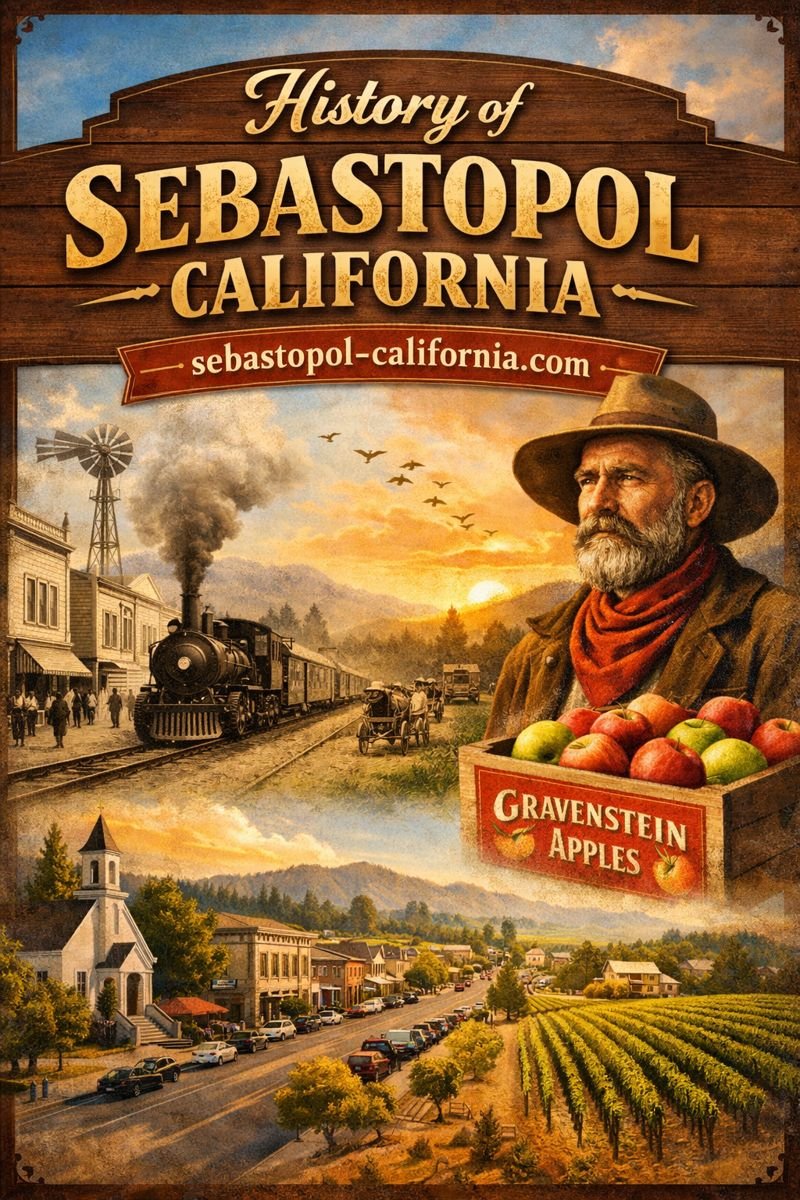
Sebastopol’s fertile soil and cool summer climate proved ideal for agriculture, particularly apple growing. The Gravenstein apple, first planted in Sonoma County in 1811, thrived in the region’s sandy soil and temperate conditions. In 1883, Nathaniel Griffith planted the first commercial Gravenstein orchard on Laguna Road, launching an industry that would define the town for generations.
By the early 1900s, Sebastopol had earned the title “Gravenstein Apple Capital of the World.” At its peak after World War II, the region boasted over 15,000 acres devoted to apple orchards—more than the acreage dedicated to wine grapes at the time. In 1910, Sebastopol hosted California’s first apple show, the Gravenstein Apple Show, establishing a tradition that continues today with the annual Gravenstein Apple Fair held each August.
Luther Burbank’s Legacy
In 1885, famed horticulturist Luther Burbank purchased a 15-acre farm in the Gold Ridge district of Sebastopol, complementing his home in Santa Rosa. For the next forty years, Burbank conducted large-scale plant experiments on this property, commuting the 17-mile round trip by bicycle.
During his remarkable career, Burbank introduced over 800 varieties of fruits, flowers, vegetables, and grains. His Sebastopol farm was where he developed many of California’s famous plums and prunes, the ancestor of the Idaho potato, the beloved Shasta Daisy, and innovative creations such as plumcots, thornless blackberries, and spineless cactus.
Today, three acres of his original farm remain as Luther Burbank’s Gold Ridge Experiment Farm, featuring a Royal Walnut tree he planted in 1885 and a remarkable apple tree that can produce 25 different varieties. The farm was placed on the National Register of Historic Places in 1978 and is maintained by the Western Sonoma County Historical Society.
The Railroad Era
The arrival of the Northwestern Pacific Railroad in 1890 transformed Sebastopol into a major shipping hub for agricultural products. In 1904, an electric train—the Petaluma and Santa Rosa Railroad—began carrying passengers between Petaluma, Santa Rosa, and Sebastopol.
The historic Hogan Building, which served as the power house for this electric railway, was built of local quarry stone and is one of the few structures in the area to survive the devastating 1906 earthquake. The railroad tracks ran down Main Street until the late 1980s, with Sebastopol being one of the last towns in Northern California to have working trains on its main thoroughfare.
City Incorporation
Sebastopol was officially incorporated as a city on June 13, 1902, establishing a manager-council form of government that continues to this day. At the time of incorporation, the town was a thriving agricultural hub with multiple canneries processing apples and other produce for markets across America.
A Diverse Community
The early 20th century brought waves of immigrants from Italy, Portugal, China, and Japan to Sebastopol. The town’s Japanese community established the Enmanji Temple, an authentic Buddhist temple built in the 1930s that still stands today. Remarkably, Sebastopol once had two separate Chinatowns—a rare occurrence for a town of its size—each with its own joss house (place of worship).
Modern Sebastopol
Today, Sebastopol maintains its reputation as an independent, progressive community. In 1985, the city became a nuclear-free zone, and it later became the second city in California (after Lancaster) to require solar panels on all new homes. The town does not use pesticides in city landscaping.
While wine grapes have largely replaced apple orchards—the region is now part of the prestigious Russian River Valley AVA—Sebastopol celebrates its apple heritage through the annual Gravenstein Apple Fair and Apple Blossom Festival. The creation of The Barlow, a $32 million marketplace built on former agricultural warehouses, has transformed Sebastopol into a Wine Country destination featuring dining, tasting rooms, and artisan shops.
Sebastopol is also known for its vibrant arts scene, exemplified by Florence Avenue’s famous “Junk Art” sculptures created by artists Patrick Amiot and Brigitte Laurent since 2001. The city is home to national food and beverage producers including Guayakí yerba mate, Traditional Medicinals teas, and Ace Cider (founded 1993).
Sebastopol Quick Facts
- 📍 Location: Sonoma County, California
- 👥 Population: 7,521 (2020 Census)
- 📅 Incorporated: June 13, 1902
- 🍎 Original Name: Pine Grove (changed to Sebastopol circa 1857)
- 🏛️ Government: Council-Manager
- 🛣️ Notable Highway: Gravenstein Highway (CA Route 116)
Advertisement
THE INVENTOR’S VELOCITY
Web Development & Digital Marketing
Need a professional website for your Sebastopol business?
WordPress • Local SEO • Business Directories • Responsive Design
Helping local businesses thrive online
Visit Sebastopol Today
From its indigenous roots to its agricultural heritage and modern-day charm, Sebastopol offers visitors a unique blend of history, culture, and Wine Country sophistication. Whether you’re exploring Luther Burbank’s experimental farm, sampling craft ciders at a local cidery, or browsing the artisan shops at The Barlow, you’ll discover why this quirky, creative community has captured the hearts of residents and visitors alike for over 170 years.
Sources: City of Sebastopol, Western Sonoma County Historical Society, Sonoma County Tourism, Wikipedia
Information accurate as of 2025